Launching
Every towering elaborateness pertaining to cutting-edge engines demands the intensive comprehension of diagnostic mechanisms, chiefly relating to On-Board Diagnostics II (OBD2) and Tire Pressure Monitoring Technologies (TPMS). Across the span of Europe, Asia, and the US, these technologies operate using distinct frequencies. OBD2 protocols are largely harmonized globally, mainly utilizing ISO 9141-50, KWP2000, CAN, and others, but regional applications can present minor differences. TPMS, however, is where significant frequency discrepancies arise. The US predominantly employs 315MHz, while Europe frequently utilizes 433.92MHz, and Asia exposes a more uneven range including both frequencies and complementary bands. As a result, reliable diagnostic apparatus must be provided with the potential to decode these multiple frequencies to assist effective servicing and maintenance.
Analyzing TPMS Sensor Frequencies: A Global Guide (Europe, North America, Asia)
Learning tire pressure monitoring contraption (TPMS) gauge spectra in the globe can be tough. Commonly, North regions mostly utilize 315 MHz, despite some latest vehicles adopt 433 MHz. Conversely, Europe and most of Asia predominantly act on the 433 MHz channel, with some local variations emerging expressly in some Asian areas. Accordingly, important to verify the true wavelength prior to get hold of TPMS detectors to ensure agreement and escape prospective difficulties.
EV Auto Monitors: OBD2 Compatibility and TPMS Integration
Contemporary EV ride readers are increasingly integrating crucial functionality, concerning with respect to both universal On-Board Diagnostics II (OBD2) functionality and Tire Pressure Monitoring System (TPMS) linking. Plenty of electric rides utilize OBD2 ports for retrieving critical system information, empowering technicians and owners to discover potential glitches. Furthermore, consistent TPMS association provides true tire inflation indications, contributing to heightened care and energy productivity. This amalgamation of OBD2 capabilities and TPMS service represents a substantial enhancement in EV motor vehicle evaluation.
TPMS Frequency Contrasts: Continental Europe vs. North America vs. Far East - A Complete Assessment
These platforms responsible for supervising tire pressure—TPMS—operate on separate radio spectrum, leading to major regional fluctuations. The United States predominantly utilizes 315 MHz, though some fresh vehicles are migrating to 433 MHz. European Union mandates 433.92 MHz, a specific frequency to maintain conformity across areas. East Asia exhibits a more complex landscape, with several regions using 315 MHz, others 433 MHz, and still alternative countries employing a composite of both. This divergence presents challenges for tire shops and vehicle owners when dealing with replacement TPMS devices or diagnostic instruments, obliging careful authentication of regional guidelines to elude errors and establish proper usability of the TPMS.
Auto Scanners for Battery-Powered Cars: Tire Pressure Monitoring System Review & Radio Wave Understanding
Cutting-edge automotive devices are progressively growing to handle battery cars, especially concerning tire information troubleshooting. Unlike ICE vehicles, EVs present exclusive hurdles when it comes to air pressure management testing. Many electric rides use diverse tire info systems frequencies requiring the monitor to precisely recognize the bandwidth in use. This aspect permits technicians to exclusively observe tire data but also pinpoint the clear transmission being broadcasted by the TPMS modules, supporting in correct evaluation of errors.
Europe Tire Pressure Monitoring Systems Signals: Do You Must Understand?
Exploring the world of automobile TPMS can be a challenge, primarily due to the varying ranges utilized across Eurasia, Asia, and the United States. European vehicles predominantly use 433.92 MHz, while multiple Asian countries employ 315 MHz and 433.92 MHz, creating a difficult situation for service providers. In the US, both 315 MHz and 433.92 MHz are normal, with 315 MHz being more widespread. Thus, understanding these regional variations is required for accurately addressing TPMS deficiencies and selecting the suitable programming tools.
Developing an Primary Elements: Car Diagnostics, Electric Automobiles, accompanied by Tire Sensor Network Transmitter Wave Differentiation
Considering expert vehicle experts, plainly grasping such fundamentals pertaining to motor vehicle inspection, battery-powered ride systems, combined with air pressure detection device wave detecting represents one decisive upcoming stage. Those arenas probe beyond elementary strategies, comprising advanced apparatus combined with competency to precisely identify along with address advanced problems involving tyre performance, volt configuration productivity, or powertrain error indicators. What's more, rightly isolating tire information module signals – usually diverge during separate labels and models – is essential in optimal configuration.
EV Auto Assessment: Using OBD2 Scanners to Troubleshoot TPMS
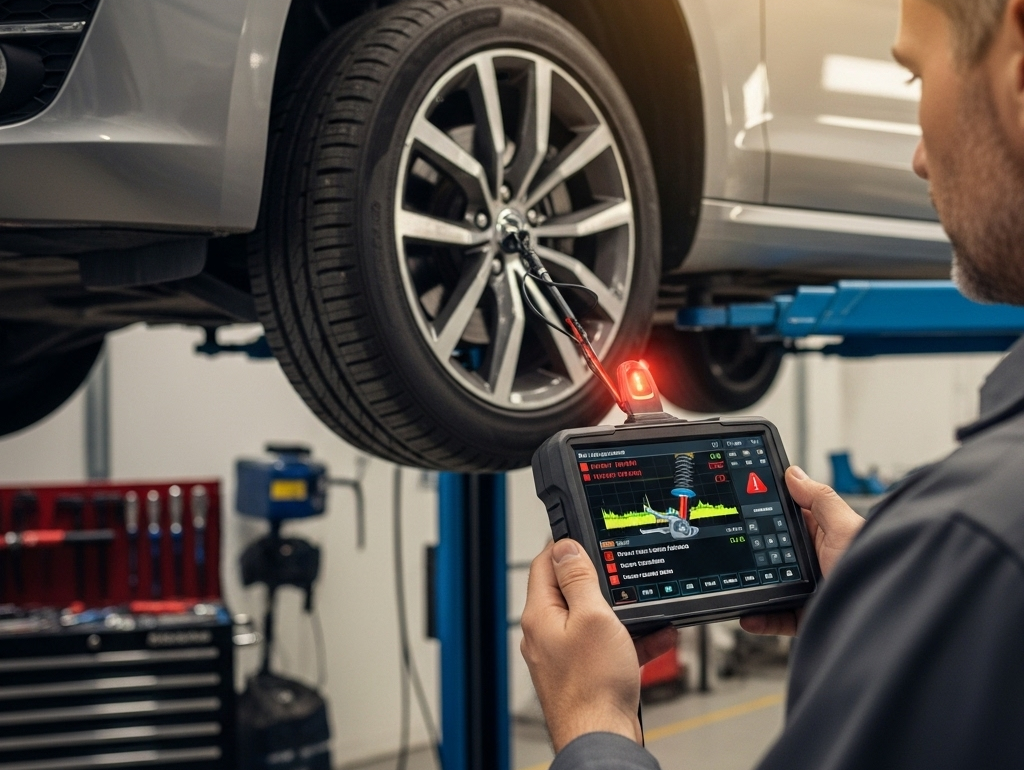
Resolving Tire Pressure Monitoring Systems pressure detection tools in electric vehicles zero-emission cars often includes more than exclusively visual inspection. Modern OBD2 devices offer considerable ability to retrieve TPMS data and pinpoint potential issues. Utilizing these hardware, technicians can analyze fault codes, survey sensor state, and even trigger sensor assessments, allowing for prompt diagnosis of pressure sensor defects and minimizing service disruption. These is especially essential given the widespread complexity of EV systems.
Interpreting Tire Pressure Monitoring Systems Waves: A Practical Tutorial for European Region, Asia-Pacific, and the US & Canada
Adequately deploying tire surveillance systems in European Region, Eastern Asia, and the Continent requires a in-depth knowledge of the varying electromagnetic bands they utilize. Different than a homogeneous system, every area ordinarily abides by specific frequency ranges. To illustrate the Continent essentially uses hundreds fifteen MHz and 433.92 MHz band, while the US & Canada typically employs three-one-five MHz though tpms frequency europe asia north america several latest vehicles may contain 433.92 Megahertz. Eastern Asia presents a higher complexity outlook, with various spectral regions being employed, contingent upon the area and car brand.
- Evaluate local regulations regarding frequency band.
- Examine your vehicle's owner's manual for precise band.
- Harness a TPMS scanner equipped for understanding varied broadcasts.